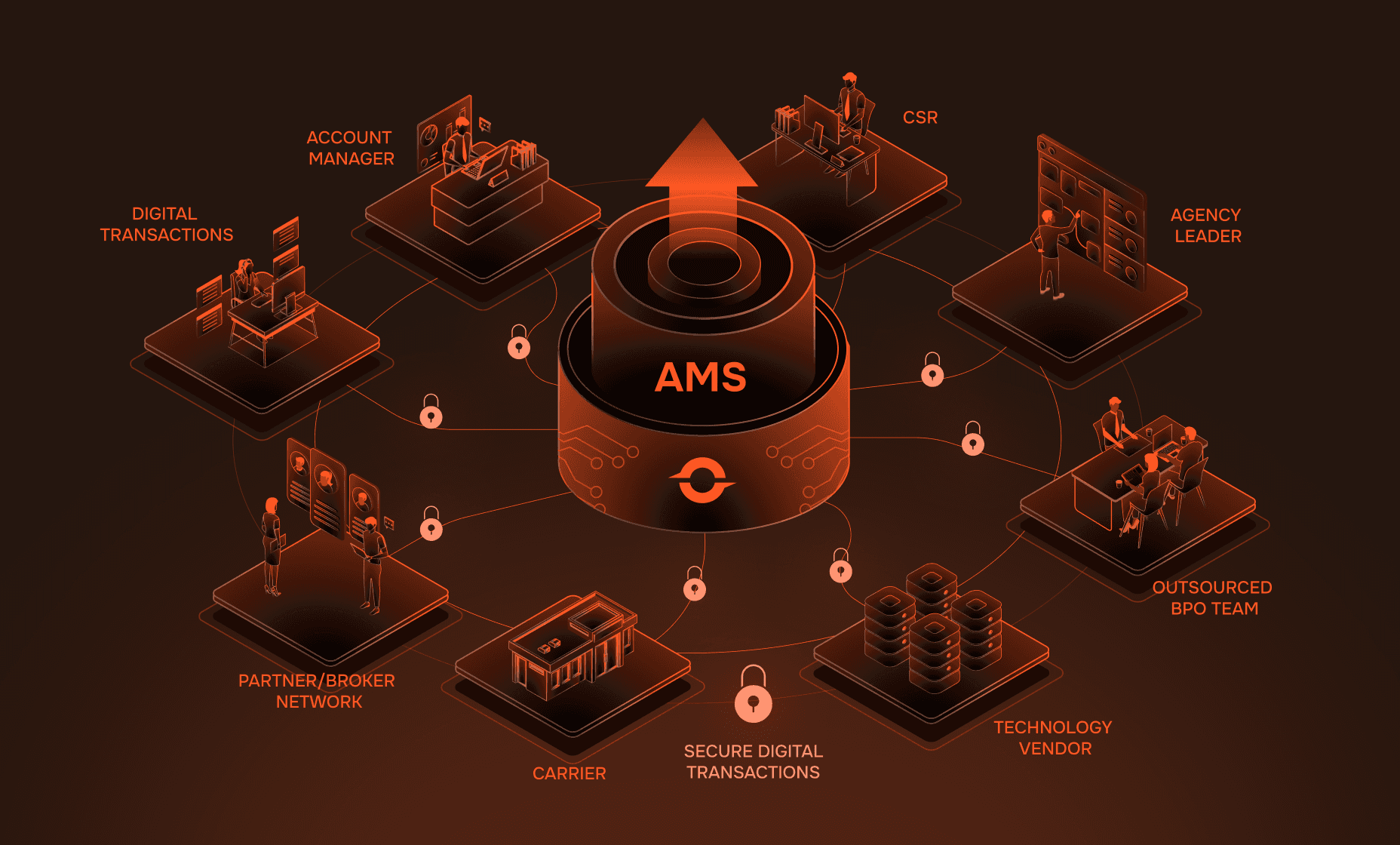
Agency leaders have invested in AMS platforms, workflow tools, integrations, reporting, audits, outsourcing, and process improvement. Yet many still feel like they are not getting the full return they expected.
The data is still incomplete. Reports still need cleanup. Service teams still rekey information. Producers still work from emails and spreadsheets. Account managers still compare documents manually. Operations leaders still build processes to compensate for gaps. And E&O exposure is still accepted as part of the business.
It is easy to blame the AMS because that is where the pain becomes visible.
But that is the wrong diagnosis. Your AMS is not the problem. The leak around your AMS is the problem.
The AMS was designed to be the system of record. It is supposed to hold the truth of the agency: client information, policy details, coverage data, activity history, workflows, reporting, and operational visibility.
But in commercial insurance, the truth is created outside the AMS.
It is created in client conversations, intake documents, SOVs, ACORD forms, submissions, quotes, policies, endorsements, proposals, loss runs, carrier emails, service requests, spreadsheets, and the interpretation of all those pieces together.
That last part matters. The truth is not always a clean data field waiting to be copied. Sometimes it is what changed from last year to this year. Sometimes it is the relationship between a quote, a binder, and a policy. Sometimes it is a discrepancy buried inside an endorsement. Sometimes it is the judgment of an experienced account manager who knows something does not look right.
Today, that truth still depends heavily on humans to make its way back into the AMS. That is where the leak happens.
Some information gets entered. Some gets entered late. Some gets entered incompletely. Some gets interpreted differently. Some stays buried in emails, PDFs, carrier portals, spreadsheets, or someone’s notes.
The result is simple: the AMS is expected to be the source of truth, but it often operates with only part of the truth.
"The leak is the gap between where the truth is created and where the truth is supposed to live."
The Cost of the Leak
The top 100 U.S. insurance brokers generated $75.5 billion in revenue in 2023. Large brokerages often operate at net profit margins of 18% to 20%, which means 80% to 82% of revenue is absorbed by operating costs.
Much of that cost is necessary. Commercial insurance is a service-intensive business. Talent matters. Client relationships matter. Carrier relationships matter. Claims advocacy matters. Compliance matters. Technology matters.
But not every dollar in the operating model is creating client value or growth. A meaningful portion is spent managing the gap between where the truth is created and where the record is supposed to live.
Conservative estimates suggest this leak represents $9 billion to $12 billion of annual industry cost through labor, rework, compensating technology, outsourced processing, data cleanup, and E&O exposure.
This is not a $10 billion AMS problem. It is a $10 billion information flow problem.
Why the Leak Exists
This problem was not created by bad employees, weak operations teams, or poor AMS vendors.
The real reason is simpler.
Commercial insurance work is not just data movement. It is interpretation.
A good account manager is not simply copying information from one place to another. They are asking whether the policy matches the quote, whether the endorsement changed coverage, whether the proposal reflects the actual carrier terms, whether the loss run changes the renewal strategy, and whether anything creates client risk or E&O exposure.
That work requires two skills at the same time.
It requires deterministic execution: confirm the named insured, effective date, premium, limits, deductible, locations, forms, and endorsements.
It also requires judgment: what changed, what is missing, what feels off, what needs carrier clarification, what should be escalated, and what could create risk.
That balance takes years to learn. For decades, there was no technology that could reliably perform that work at scale. Humans were the only practical answer.
So humans became the pipe between the source of truth and the system of record.
That is why the leak existed.
How the Industry Managed Around It
When a problem cannot be fixed at the source, smart operators manage around it. That is exactly what agencies did.
Hired more people. Account managers, CSRs, operations teams, and outsourced resources became the bridge between the documents and the AMS.
Added more technology. Reporting tools, workflow systems, audits, integrations, BI, middleware, and data infrastructure were layered in to monitor, reconcile, and compensate for incomplete information.
Outsourced more work. BPO providers helped reduce unit cost, but they often moved manual work to a different location, sometimes with less context, more handoffs, and less direct accountability.
Accepted the risk. E&O coverage became part of the operating model because some level of error was treated as unavoidable.
These responses were rational. But they were still workarounds. They were expensive responses to a problem the industry could not yet solve
This is why AMS sentiment became complicated. The AMS became the visible place where the pain appeared. When reports were wrong, leaders saw it in the AMS. When data was incomplete, they saw it in the AMS. When renewal workflows broke down, they saw it in the AMS.
But the AMS was not the cause of the disappointment. It was the place where the upstream problem became visible.
The ROI problem was not that the AMS had no value. The problem was that the AMS was never consistently fed the truth it needed to unlock its full value.
What Changed
AI changes the equation.
For the first time, technology can help read commercial insurance documents, understand context, extract information, compare changes, identify inconsistencies, validate data, and move clean structured information back into the AMS.
This is not about replacing the AMS. It is about making the AMS more valuable.
The AMS was designed to be the system of record. But a system of record is only as valuable as the information flowing into it. When AI connects the source of truth in documents, workflows, and conversations to the AMS, the agency operating model starts to change.
Reports become more reliable. Workflows become cleaner. Renewals become more proactive. Service becomes faster. Rework declines. Manual entry declines. E&O exposure can shrink. Revenue per employee can improve. Leadership gets better visibility. Teams spend less time managing administrative drag and more time advising clients and supporting growth.
The future is not AMS versus AI. The future is AI helping the AMS finally achieve the purpose it was created for.
The Three Paths Agencies Are Taking
Agency leaders are moving in three directions.
The first path is wait and see. That feels safe because AI is moving fast and the market is still forming. But waiting has a cost. Agencies moving now are not just buying software. They are learning how to redesign workflows, train teams, govern usage, measure outcomes, and change behavior across the organization.
Waiting feels safe until you realize your competitors are learning how to operate differently
The second path is generic AI. Tools like ChatGPT, Copilot, and Gemini can help individuals work faster. They can draft emails, summarize documents, and improve personal productivity.
But commercial insurance operations are not generic knowledge work. Accuracy matters. Security matters. Auditability matters. Compliance matters. Endorsement nuance matters. Policy language matters. Knowing when AI is uncertain matters.
Generic AI can help individuals. It does not fix the structural leak. In insurance, good enough is not good enough. Faster mistakes are still mistakes.
The third path is point solutions. Some agencies are buying one AI tool for submissions, another for policy checking, another for proposals, another for renewals, and another for servicing.
That can create quick wins. But it can also recreate the original fragmentation in a new digital form. More tools. More data models. More integrations. More adoption curves. More places where information gets trapped.
You do not fix one leaky pipe by creating five new disconnected pipes
How Outmarket Fixes the Pipe
Outmarket was built around a simple belief: the AMS should remain the system of record, but agencies need an intelligence and execution layer that connects the real work of the agency back to that system of record.
Outmarket completes your AMS. That matters because fixing the leaky pipe is not just a matter of adding AI to the workflow. Commercial insurance is too complex for generic AI, and agency operations are too connected for a collection of isolated point solutions.
To fix the pipe, three things have to be true: accuracy, security, and breadth.
First, the AI has to be accurate enough for insurance work. Insurance is not a “close enough” business. A wrong limit, missed endorsement, incorrect named insured, misunderstood exclusion, or incomplete policy comparison can create real client risk and E&O exposure.
That is why Outmarket is built around the right blend of deterministic control and probabilistic intelligence for each workflow. Some parts of the work need strict rules, validation, approvals, and audit trails. Other parts require interpretation, context, judgment, and pattern recognition. Outmarket has fine-tuned these workflows specifically for commercial insurance, with accuracy treated as the first principle, not a feature.
In insurance, the goal is not just faster work. The goal is faster work that is accurate, controlled, and trustworthy
Second, the platform has to be secure enough for enterprise adoption. Commercial agencies handle sensitive client, policy, financial, claims, and business information every day. Any AI platform operating in that environment has to meet the security expectations of agency leaders, clients, carriers, and enterprise IT teams.
Outmarket is built with enterprise-grade security and governance, including SOC 2 Type 2, ISO 27001, HIPAA, and GDPR compliance. Customer environments are isolated through single-tenant architecture, so agency data is not mixed with other organizations. Outmarket also supports MFA and SSO for centralized identity management and access control.
Equally important, agency data is not used to train public AI models. Outmarket follows clear privacy principles around zero data retention, deletion controls, and strict separation of customer information.
AI cannot become part of the agency operating model unless leaders trust where the data lives, how it is protected, and how it is governed.
Third, the platform has to cover the full operating lifecycle. A point solution may improve one workflow, but it does not fix the leak if the rest of the client lifecycle remains fragmented. The leak exists because information is scattered across people, systems, documents, and handoffs. Solving it requires one connected platform that supports how the agency actually operates.
Outmarket gives producers, CSRs, account managers, operations teams, and leaders one platform across intake, submissions, proposals, renewals, servicing, policy review, carrier communication, and client interaction. That breadth matters because the truth of an account does not live in one workflow. It moves across the full lifecycle of the client relationship.
Outmarket fixes the pipe because it connects the work, the people, the documents, and the AMS in one operating layer
When accuracy, security, and breadth come together, the economics of the agency begin to change. Staff can redirect time from manual processing to client-facing work. Rework declines. Outsourced data entry declines. Compensating technology becomes less necessary. E&O exposure can shrink. Service teams gain capacity. Producers get stronger support. Leaders get better visibility into the business.
Most importantly, the AMS finally receives the data it was designed to work with.
The Real ROI Conversation
The industry has spent years asking whether agencies are getting enough ROI from their AMS. That question is fair, but incomplete.
The better question is this:
How much AMS value has been trapped because the system was never consistently fed clean, complete, timely information?
For decades, agencies managed around that limitation with people, process, outsourcing, audits, integrations, reporting tools, and E&O protection.
Now there is a better option.
The pipe can be fixed. The AMS can become more valuable. The agency can operate with a different cost structure.
The leaders who move first will not just improve efficiency. They will build a more scalable operating model, a stronger client experience, better revenue per employee, and a better foundation for growth.
The leaky pipe has been accepted as normal for too long. It is not normal anymore.
The question is no longer whether the pipe can be fixed. The question is whether you fix it before your competitors do.
Agency leaders have invested in AMS platforms, workflow tools, integrations, reporting, audits, outsourcing, and process improvement. Yet many still feel like they are not getting the full return they expected.
The data is still incomplete. Reports still need cleanup. Service teams still rekey information. Producers still work from emails and spreadsheets. Account managers still compare documents manually. Operations leaders still build processes to compensate for gaps. And E&O exposure is still accepted as part of the business.
It is easy to blame the AMS because that is where the pain becomes visible.
But that is the wrong diagnosis. Your AMS is not the problem. The leak around your AMS is the problem.
The AMS was designed to be the system of record. It is supposed to hold the truth of the agency: client information, policy details, coverage data, activity history, workflows, reporting, and operational visibility.
But in commercial insurance, the truth is created outside the AMS.
It is created in client conversations, intake documents, SOVs, ACORD forms, submissions, quotes, policies, endorsements, proposals, loss runs, carrier emails, service requests, spreadsheets, and the interpretation of all those pieces together.
That last part matters. The truth is not always a clean data field waiting to be copied. Sometimes it is what changed from last year to this year. Sometimes it is the relationship between a quote, a binder, and a policy. Sometimes it is a discrepancy buried inside an endorsement. Sometimes it is the judgment of an experienced account manager who knows something does not look right.
Today, that truth still depends heavily on humans to make its way back into the AMS. That is where the leak happens.
Some information gets entered. Some gets entered late. Some gets entered incompletely. Some gets interpreted differently. Some stays buried in emails, PDFs, carrier portals, spreadsheets, or someone’s notes.
The result is simple: the AMS is expected to be the source of truth, but it often operates with only part of the truth.
"The leak is the gap between where the truth is created and where the truth is supposed to live."
The Cost of the Leak
The top 100 U.S. insurance brokers generated $75.5 billion in revenue in 2023. Large brokerages often operate at net profit margins of 18% to 20%, which means 80% to 82% of revenue is absorbed by operating costs.
Much of that cost is necessary. Commercial insurance is a service-intensive business. Talent matters. Client relationships matter. Carrier relationships matter. Claims advocacy matters. Compliance matters. Technology matters.
But not every dollar in the operating model is creating client value or growth. A meaningful portion is spent managing the gap between where the truth is created and where the record is supposed to live.
Conservative estimates suggest this leak represents $9 billion to $12 billion of annual industry cost through labor, rework, compensating technology, outsourced processing, data cleanup, and E&O exposure.
This is not a $10 billion AMS problem. It is a $10 billion information flow problem.
Why the Leak Exists
This problem was not created by bad employees, weak operations teams, or poor AMS vendors.
The real reason is simpler.
Commercial insurance work is not just data movement. It is interpretation.
A good account manager is not simply copying information from one place to another. They are asking whether the policy matches the quote, whether the endorsement changed coverage, whether the proposal reflects the actual carrier terms, whether the loss run changes the renewal strategy, and whether anything creates client risk or E&O exposure.
That work requires two skills at the same time.
It requires deterministic execution: confirm the named insured, effective date, premium, limits, deductible, locations, forms, and endorsements.
It also requires judgment: what changed, what is missing, what feels off, what needs carrier clarification, what should be escalated, and what could create risk.
That balance takes years to learn. For decades, there was no technology that could reliably perform that work at scale. Humans were the only practical answer.
So humans became the pipe between the source of truth and the system of record.
That is why the leak existed.
How the Industry Managed Around It
When a problem cannot be fixed at the source, smart operators manage around it. That is exactly what agencies did.
Hired more people. Account managers, CSRs, operations teams, and outsourced resources became the bridge between the documents and the AMS.
Added more technology. Reporting tools, workflow systems, audits, integrations, BI, middleware, and data infrastructure were layered in to monitor, reconcile, and compensate for incomplete information.
Outsourced more work. BPO providers helped reduce unit cost, but they often moved manual work to a different location, sometimes with less context, more handoffs, and less direct accountability.
Accepted the risk. E&O coverage became part of the operating model because some level of error was treated as unavoidable.
These responses were rational. But they were still workarounds. They were expensive responses to a problem the industry could not yet solve
This is why AMS sentiment became complicated. The AMS became the visible place where the pain appeared. When reports were wrong, leaders saw it in the AMS. When data was incomplete, they saw it in the AMS. When renewal workflows broke down, they saw it in the AMS.
But the AMS was not the cause of the disappointment. It was the place where the upstream problem became visible.
The ROI problem was not that the AMS had no value. The problem was that the AMS was never consistently fed the truth it needed to unlock its full value.
What Changed
AI changes the equation.
For the first time, technology can help read commercial insurance documents, understand context, extract information, compare changes, identify inconsistencies, validate data, and move clean structured information back into the AMS.
This is not about replacing the AMS. It is about making the AMS more valuable.
The AMS was designed to be the system of record. But a system of record is only as valuable as the information flowing into it. When AI connects the source of truth in documents, workflows, and conversations to the AMS, the agency operating model starts to change.
Reports become more reliable. Workflows become cleaner. Renewals become more proactive. Service becomes faster. Rework declines. Manual entry declines. E&O exposure can shrink. Revenue per employee can improve. Leadership gets better visibility. Teams spend less time managing administrative drag and more time advising clients and supporting growth.
The future is not AMS versus AI. The future is AI helping the AMS finally achieve the purpose it was created for.
The Three Paths Agencies Are Taking
Agency leaders are moving in three directions.
The first path is wait and see. That feels safe because AI is moving fast and the market is still forming. But waiting has a cost. Agencies moving now are not just buying software. They are learning how to redesign workflows, train teams, govern usage, measure outcomes, and change behavior across the organization.
Waiting feels safe until you realize your competitors are learning how to operate differently
The second path is generic AI. Tools like ChatGPT, Copilot, and Gemini can help individuals work faster. They can draft emails, summarize documents, and improve personal productivity.
But commercial insurance operations are not generic knowledge work. Accuracy matters. Security matters. Auditability matters. Compliance matters. Endorsement nuance matters. Policy language matters. Knowing when AI is uncertain matters.
Generic AI can help individuals. It does not fix the structural leak. In insurance, good enough is not good enough. Faster mistakes are still mistakes.
The third path is point solutions. Some agencies are buying one AI tool for submissions, another for policy checking, another for proposals, another for renewals, and another for servicing.
That can create quick wins. But it can also recreate the original fragmentation in a new digital form. More tools. More data models. More integrations. More adoption curves. More places where information gets trapped.
You do not fix one leaky pipe by creating five new disconnected pipes
How Outmarket Fixes the Pipe
Outmarket was built around a simple belief: the AMS should remain the system of record, but agencies need an intelligence and execution layer that connects the real work of the agency back to that system of record.
Outmarket completes your AMS. That matters because fixing the leaky pipe is not just a matter of adding AI to the workflow. Commercial insurance is too complex for generic AI, and agency operations are too connected for a collection of isolated point solutions.
To fix the pipe, three things have to be true: accuracy, security, and breadth.
First, the AI has to be accurate enough for insurance work. Insurance is not a “close enough” business. A wrong limit, missed endorsement, incorrect named insured, misunderstood exclusion, or incomplete policy comparison can create real client risk and E&O exposure.
That is why Outmarket is built around the right blend of deterministic control and probabilistic intelligence for each workflow. Some parts of the work need strict rules, validation, approvals, and audit trails. Other parts require interpretation, context, judgment, and pattern recognition. Outmarket has fine-tuned these workflows specifically for commercial insurance, with accuracy treated as the first principle, not a feature.
In insurance, the goal is not just faster work. The goal is faster work that is accurate, controlled, and trustworthy
Second, the platform has to be secure enough for enterprise adoption. Commercial agencies handle sensitive client, policy, financial, claims, and business information every day. Any AI platform operating in that environment has to meet the security expectations of agency leaders, clients, carriers, and enterprise IT teams.
Outmarket is built with enterprise-grade security and governance, including SOC 2 Type 2, ISO 27001, HIPAA, and GDPR compliance. Customer environments are isolated through single-tenant architecture, so agency data is not mixed with other organizations. Outmarket also supports MFA and SSO for centralized identity management and access control.
Equally important, agency data is not used to train public AI models. Outmarket follows clear privacy principles around zero data retention, deletion controls, and strict separation of customer information.
AI cannot become part of the agency operating model unless leaders trust where the data lives, how it is protected, and how it is governed.
Third, the platform has to cover the full operating lifecycle. A point solution may improve one workflow, but it does not fix the leak if the rest of the client lifecycle remains fragmented. The leak exists because information is scattered across people, systems, documents, and handoffs. Solving it requires one connected platform that supports how the agency actually operates.
Outmarket gives producers, CSRs, account managers, operations teams, and leaders one platform across intake, submissions, proposals, renewals, servicing, policy review, carrier communication, and client interaction. That breadth matters because the truth of an account does not live in one workflow. It moves across the full lifecycle of the client relationship.
Outmarket fixes the pipe because it connects the work, the people, the documents, and the AMS in one operating layer
When accuracy, security, and breadth come together, the economics of the agency begin to change. Staff can redirect time from manual processing to client-facing work. Rework declines. Outsourced data entry declines. Compensating technology becomes less necessary. E&O exposure can shrink. Service teams gain capacity. Producers get stronger support. Leaders get better visibility into the business.
Most importantly, the AMS finally receives the data it was designed to work with.
The Real ROI Conversation
The industry has spent years asking whether agencies are getting enough ROI from their AMS. That question is fair, but incomplete.
The better question is this:
How much AMS value has been trapped because the system was never consistently fed clean, complete, timely information?
For decades, agencies managed around that limitation with people, process, outsourcing, audits, integrations, reporting tools, and E&O protection.
Now there is a better option.
The pipe can be fixed. The AMS can become more valuable. The agency can operate with a different cost structure.
The leaders who move first will not just improve efficiency. They will build a more scalable operating model, a stronger client experience, better revenue per employee, and a better foundation for growth.
The leaky pipe has been accepted as normal for too long. It is not normal anymore.
The question is no longer whether the pipe can be fixed. The question is whether you fix it before your competitors do.



Ready to Transform Your Agency?
Ready to Transform Your Agency?
Ready to Transform Your Agency?
Outmarket AI raises $34.5M Series B to fuel the AI Operating System for Insurance.
Outmarket AI raises $34.5M Series B to fuel the AI Operating System for Insurance.
AI for insurance brokerages. Trusted by 300+ agencies. SOC 2 Type II, ISO/IEC 27001:2022 Certified, ISO/IEC 42001 Certified, and HIPAA-compliant.
AI for insurance brokerages. Trusted by 300+ agencies. SOC 2 Type II, ISO/IEC 27001:2022 Certified, ISO/IEC 42001 Certified, and HIPAA-compliant.
AI for insurance brokerages. Trusted by 300+ agencies. SOC 2 Type II, ISO/IEC 27001:2022 Certified, ISO/IEC 42001 Certified, and HIPAA-compliant.
Platform