
A few weeks ago, I was in a conversation with a commercial insurance leader debating AI deployment strategy. His perspective was thoughtful and practical. "Why roll this out broadly?" he asked. "Wouldn't it make more sense to focus AI on a smaller group of highly productive people first?" Honestly, five years ago I probably would have agreed.
Enterprise software historically worked that way. You identified the power users. You optimized productivity. You drove efficiency. You justified ROI.
That playbook made sense when technology primarily acted as a workflow accelerator.
But after spending the last year inside agencies actually deploying AI into real commercial insurance operations, I no longer think this transformation is mainly about productivity.
I think we are watching the early stages of a much bigger shift.
And the agencies that misunderstand this are going to believe they are ahead right up until they realize someone else completely changed the game.
Because what I am seeing inside agencies right now is not theoretical. It is operational.
An account manager processed 61 certificates of insurance in under three hours. Work that previously stretched across multiple days was completed before lunch.
A broker team implemented an AI driven workflows across the full lifecycle of client journey and reduced errors found during the policy check from 44% to 14% within weeks.
Not long after, the number dropped into single digits because the system continuously learned from additional context and surfaced inconsistencies humans repeatedly missed.
A risk management team proactively analyzed every PSE account before a major storm. Coverage exposure, policy structure, weather risk, all analyzed automatically.
The result? Zero uncovered exposure issues after the storm.
And this is the important part. That effort did not stay a special project. It became operational behavior.
Another producer used AI-driven tower analysis before the first client meeting. They mapped layered coverage, identified gaps and binder discrepancies the incumbent broker had missed for years. They walked into the meeting with evidence. They walked out with the account with policy premium of $500,000.
I recently spoke with an agency owner trying to grow from $100M to $250M organically. What caught my attention was not the target. It was the strategy. He was not talking about squeezing more hours out of his staff. He was not talking about hiring aggressively. He was not talking about reducing service levels.
He was talking about scaling expertise. Scaling judgment. Scaling service quality. Scaling risk intelligence.
That is a completely different conversation.
And that is why I think the most dangerous position in commercial insurance AI today is believing you are ahead because your workflows got a little faster.
Because somewhere nearby, another agency is redesigning how intelligence itself operates across their business.
Most Agencies Still Think AI Is About Productivity
I spend a lot of time talking with brokers, producers, account managers, operations leaders, and agency owners.
Many of them grew up in this industry. Insurance is part of their identity.
Almost all of them immediately understand the productivity benefits of AI.
Faster certificates. Faster renewal prep. Faster submissions. Faster proposals. Less repetitive work.
Those gains matter. They are real.
But I increasingly believe productivity is just Level 1.
The mistake many agencies are making is assuming early productivity wins equal transformation, because the gains are enormous and feels like a transformation. But, that is just winning a battle.
The agencies pulling ahead are doing something much more important.
They are using AI to rethink:
How expertise scales
How client service scales
How risk gets identified earlier
How institutional knowledge spreads
How better decisions happen faster
How growth happens without linear headcount expansion
That is not automation. That is organizational redesign. That is the war you need win
Knowledge Is No Longer the Advantage It Used To Be
For most of commercial insurance history, brokers won because they knew more than the client.
And to be fair, that knowledge mattered.
Coverage structure. Exclusions. Carrier behavior. Claims exposure. Regulatory nuance.
The ability to translate complex insurance language into business impact created enormous value.
But something fundamental is changing.
Knowledge itself is becoming accessible.
Today, any client can ask AI:
"What cyber exclusions should I worry about?" "What questions should I ask my broker?" "Where are common gaps in D&O coverage?"
That changes the game.
It does not eliminate the value of brokers. But it changes where the value comes from.
Because clients are no longer only evaluating who knows more.
Increasingly, they are evaluating:
Who identifies issues faster. Who explains risk more clearly. Who acts sooner. Who prevents problems. Who creates measurable outcomes.
Knowledge is becoming accessible. Execution is becoming the moat.
Anybody can explain a policy. Very few people can identify a dangerous gap before a claim occurs.
That difference matters.
Service Is Becoming The New Sales
This may be the biggest shift of all.
I spent most of my career in enterprise sales. And one thing became very clear over time. Clients rarely become loyal because of presentations. They become loyal because of moments.
Moments where they feel:
"They caught something nobody else saw."
"They moved faster than everyone else."
"They protected us before the issue became real."
Those moments create trust. And trust compounds.
The best agencies always understood this. Exceptional service has always driven retention and referrals.
What AI changes is scale.
Historically, only your best employees could consistently operate at that level. Now agencies are beginning to operationalize that level of intelligence across much broader teams.
That changes client expectations.
And once clients experience proactive service at that level, going backward becomes very difficult.
The Next E&O Battle Is Already Starting
One thing I think the industry is underestimating is how AI changes E&O exposure.
Because your clients are using AI. Your competitors are using AI. Your carriers are using AI. Claims adjusters are using AI.
Which means inconsistencies that previously stayed buried inside policies are becoming easier to find.
Coverage gaps. Missing documentation. Binder discrepancies. Conflicting endorsements. And increasingly, competitors can discover these issues during renewal reviews before the incumbent broker even realizes they exist.
That changes E&O from being purely a claims issue. Now it becomes a retention issue too.
The agencies responding best are not waiting for problems to surface.
They are proactively reviewing books of business using AI before clients, competitors, or carriers expose weaknesses for them.
That is not simple workflow automation. That is organizational risk intelligence. Huge difference.
The Real Shift Is Institutionalized Judgment
The more time I spend around AI deployments, the more convinced I become that the long-term value is not replacing manual work. The real opportunity is scaling judgment.
Commercial insurance has always been a team sport.
The best producer in your agency sees things others miss. The best account manager catches patterns others overlook. The best service people know how to de-escalate risk before it becomes conflict.
Historically, much of that expertise stayed trapped inside individuals. Now it does not have to.
When a senior producer improves an AI recommendation, that learning can become operational behavior for the agency.
When an account manager identifies recurring exposure patterns, that insight can become discoverable across teams.
The agencies doing this well create a flywheel:
Top performers improve faster
Mid-level performers level up quicker
New employees ramp dramatically faster
That is not automation.
That is institutionalized judgment.
And I think this becomes even more important because expertise itself is changing.
The best experts tomorrow may not simply be the people with the most historical knowledge.
They may be the people who:
Recognize patterns fastest
Adapt fastest
Challenge assumptions fastest
Learn fastest
Operationalize insight fastest
That is a very different model than traditional expertise accumulation.
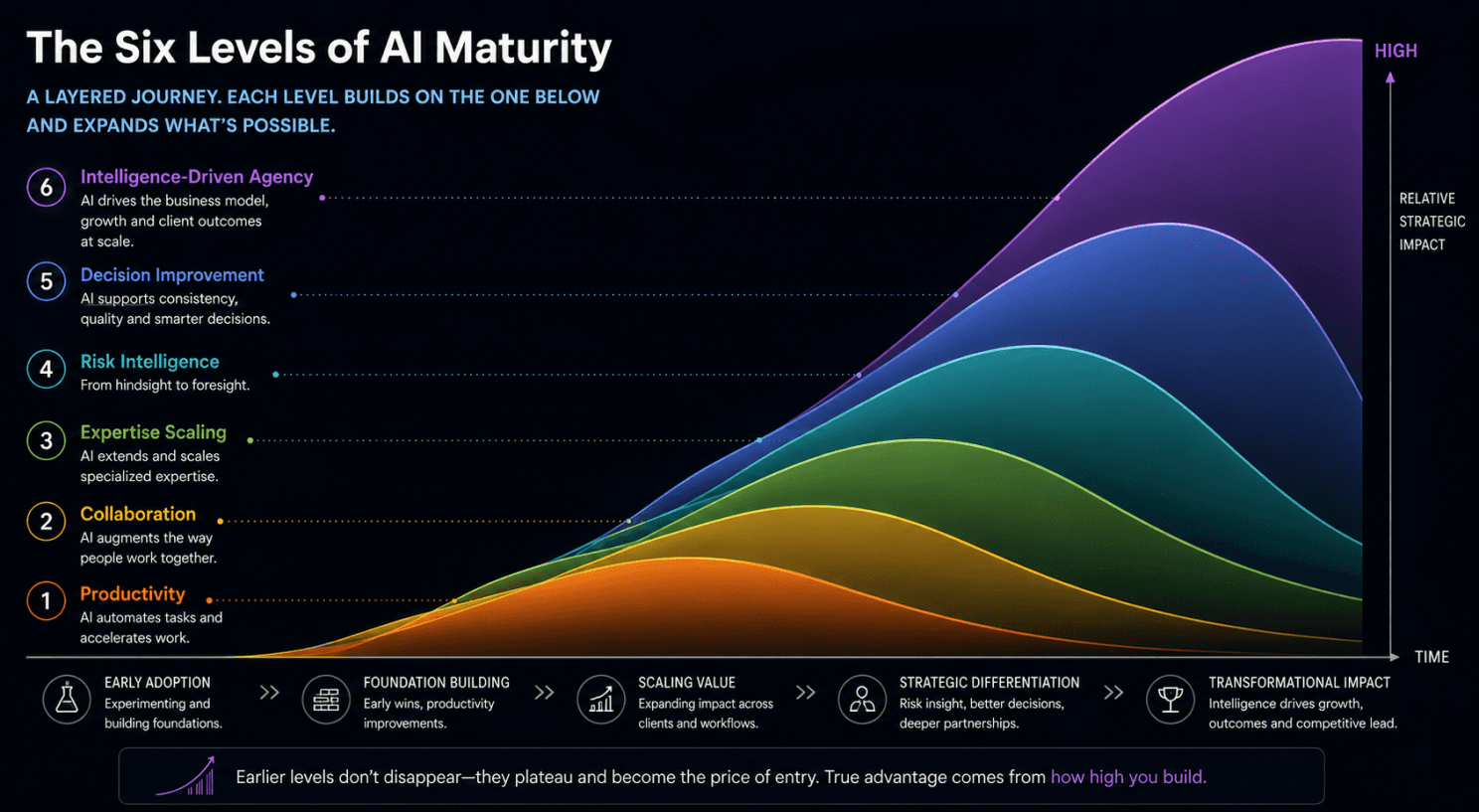
The Six Levels of AI Maturity
After watching agencies deploy AI in wildly different ways, I no longer think adoption is the right lens.
Maturity is. Because two agencies can both claim: "We use AI."
And still operate at completely different levels.
One is automating tasks. The other is redesigning how intelligence operates.
The maturity curve I increasingly see looks like this:
Level 1 — Productivity
AI saves time.
Level 2 — Collaboration
Teams operate with shared context and better coordination.
Level 3 — Expertise Scaling
Your best people improve everyone else.
Level 4 — Risk Intelligence
AI identifies issues before clients, carriers, or claims do.
Level 5 — Decision Improvement
AI challenges assumptions and improves judgment quality.
Level 6 — Intelligence-Driven Agency
The agency scales intelligence and expertise, not just headcount.
That is where the real transformation begins.
My Current View
I do not think the agencies that win with AI will necessarily be the ones with the most tools.
I think they will be the ones that learn how to:
Operationalize expertise
Improve judgment quality
Reduce invisible risk
Move faster
Create measurable client outcomes
Scale intelligence across the organization
The agencies I referenced earlier are not magical. They simply started earlier, and in moments of exponential change, early learning compounds very quickly.
Commercial insurance historically has not rewarded first movers. I understand the hesitation.
But I also think the cost of waiting is becoming materially larger than most leaders realize. Because this shift is no longer about who automates faster.
It is about who learns how to scale intelligence first.
A few weeks ago, I was in a conversation with a commercial insurance leader debating AI deployment strategy. His perspective was thoughtful and practical. "Why roll this out broadly?" he asked. "Wouldn't it make more sense to focus AI on a smaller group of highly productive people first?" Honestly, five years ago I probably would have agreed.
Enterprise software historically worked that way. You identified the power users. You optimized productivity. You drove efficiency. You justified ROI.
That playbook made sense when technology primarily acted as a workflow accelerator.
But after spending the last year inside agencies actually deploying AI into real commercial insurance operations, I no longer think this transformation is mainly about productivity.
I think we are watching the early stages of a much bigger shift.
And the agencies that misunderstand this are going to believe they are ahead right up until they realize someone else completely changed the game.
Because what I am seeing inside agencies right now is not theoretical. It is operational.
An account manager processed 61 certificates of insurance in under three hours. Work that previously stretched across multiple days was completed before lunch.
A broker team implemented an AI driven workflows across the full lifecycle of client journey and reduced errors found during the policy check from 44% to 14% within weeks.
Not long after, the number dropped into single digits because the system continuously learned from additional context and surfaced inconsistencies humans repeatedly missed.
A risk management team proactively analyzed every PSE account before a major storm. Coverage exposure, policy structure, weather risk, all analyzed automatically.
The result? Zero uncovered exposure issues after the storm.
And this is the important part. That effort did not stay a special project. It became operational behavior.
Another producer used AI-driven tower analysis before the first client meeting. They mapped layered coverage, identified gaps and binder discrepancies the incumbent broker had missed for years. They walked into the meeting with evidence. They walked out with the account with policy premium of $500,000.
I recently spoke with an agency owner trying to grow from $100M to $250M organically. What caught my attention was not the target. It was the strategy. He was not talking about squeezing more hours out of his staff. He was not talking about hiring aggressively. He was not talking about reducing service levels.
He was talking about scaling expertise. Scaling judgment. Scaling service quality. Scaling risk intelligence.
That is a completely different conversation.
And that is why I think the most dangerous position in commercial insurance AI today is believing you are ahead because your workflows got a little faster.
Because somewhere nearby, another agency is redesigning how intelligence itself operates across their business.
Most Agencies Still Think AI Is About Productivity
I spend a lot of time talking with brokers, producers, account managers, operations leaders, and agency owners.
Many of them grew up in this industry. Insurance is part of their identity.
Almost all of them immediately understand the productivity benefits of AI.
Faster certificates. Faster renewal prep. Faster submissions. Faster proposals. Less repetitive work.
Those gains matter. They are real.
But I increasingly believe productivity is just Level 1.
The mistake many agencies are making is assuming early productivity wins equal transformation, because the gains are enormous and feels like a transformation. But, that is just winning a battle.
The agencies pulling ahead are doing something much more important.
They are using AI to rethink:
How expertise scales
How client service scales
How risk gets identified earlier
How institutional knowledge spreads
How better decisions happen faster
How growth happens without linear headcount expansion
That is not automation. That is organizational redesign. That is the war you need win
Knowledge Is No Longer the Advantage It Used To Be
For most of commercial insurance history, brokers won because they knew more than the client.
And to be fair, that knowledge mattered.
Coverage structure. Exclusions. Carrier behavior. Claims exposure. Regulatory nuance.
The ability to translate complex insurance language into business impact created enormous value.
But something fundamental is changing.
Knowledge itself is becoming accessible.
Today, any client can ask AI:
"What cyber exclusions should I worry about?" "What questions should I ask my broker?" "Where are common gaps in D&O coverage?"
That changes the game.
It does not eliminate the value of brokers. But it changes where the value comes from.
Because clients are no longer only evaluating who knows more.
Increasingly, they are evaluating:
Who identifies issues faster. Who explains risk more clearly. Who acts sooner. Who prevents problems. Who creates measurable outcomes.
Knowledge is becoming accessible. Execution is becoming the moat.
Anybody can explain a policy. Very few people can identify a dangerous gap before a claim occurs.
That difference matters.
Service Is Becoming The New Sales
This may be the biggest shift of all.
I spent most of my career in enterprise sales. And one thing became very clear over time. Clients rarely become loyal because of presentations. They become loyal because of moments.
Moments where they feel:
"They caught something nobody else saw."
"They moved faster than everyone else."
"They protected us before the issue became real."
Those moments create trust. And trust compounds.
The best agencies always understood this. Exceptional service has always driven retention and referrals.
What AI changes is scale.
Historically, only your best employees could consistently operate at that level. Now agencies are beginning to operationalize that level of intelligence across much broader teams.
That changes client expectations.
And once clients experience proactive service at that level, going backward becomes very difficult.
The Next E&O Battle Is Already Starting
One thing I think the industry is underestimating is how AI changes E&O exposure.
Because your clients are using AI. Your competitors are using AI. Your carriers are using AI. Claims adjusters are using AI.
Which means inconsistencies that previously stayed buried inside policies are becoming easier to find.
Coverage gaps. Missing documentation. Binder discrepancies. Conflicting endorsements. And increasingly, competitors can discover these issues during renewal reviews before the incumbent broker even realizes they exist.
That changes E&O from being purely a claims issue. Now it becomes a retention issue too.
The agencies responding best are not waiting for problems to surface.
They are proactively reviewing books of business using AI before clients, competitors, or carriers expose weaknesses for them.
That is not simple workflow automation. That is organizational risk intelligence. Huge difference.
The Real Shift Is Institutionalized Judgment
The more time I spend around AI deployments, the more convinced I become that the long-term value is not replacing manual work. The real opportunity is scaling judgment.
Commercial insurance has always been a team sport.
The best producer in your agency sees things others miss. The best account manager catches patterns others overlook. The best service people know how to de-escalate risk before it becomes conflict.
Historically, much of that expertise stayed trapped inside individuals. Now it does not have to.
When a senior producer improves an AI recommendation, that learning can become operational behavior for the agency.
When an account manager identifies recurring exposure patterns, that insight can become discoverable across teams.
The agencies doing this well create a flywheel:
Top performers improve faster
Mid-level performers level up quicker
New employees ramp dramatically faster
That is not automation.
That is institutionalized judgment.
And I think this becomes even more important because expertise itself is changing.
The best experts tomorrow may not simply be the people with the most historical knowledge.
They may be the people who:
Recognize patterns fastest
Adapt fastest
Challenge assumptions fastest
Learn fastest
Operationalize insight fastest
That is a very different model than traditional expertise accumulation.
The Six Levels of AI Maturity
After watching agencies deploy AI in wildly different ways, I no longer think adoption is the right lens.
Maturity is. Because two agencies can both claim: "We use AI."
And still operate at completely different levels.
One is automating tasks. The other is redesigning how intelligence operates.
The maturity curve I increasingly see looks like this:
Level 1 — Productivity
AI saves time.
Level 2 — Collaboration
Teams operate with shared context and better coordination.
Level 3 — Expertise Scaling
Your best people improve everyone else.
Level 4 — Risk Intelligence
AI identifies issues before clients, carriers, or claims do.
Level 5 — Decision Improvement
AI challenges assumptions and improves judgment quality.
Level 6 — Intelligence-Driven Agency
The agency scales intelligence and expertise, not just headcount.
That is where the real transformation begins.
My Current View
I do not think the agencies that win with AI will necessarily be the ones with the most tools.
I think they will be the ones that learn how to:
Operationalize expertise
Improve judgment quality
Reduce invisible risk
Move faster
Create measurable client outcomes
Scale intelligence across the organization
The agencies I referenced earlier are not magical. They simply started earlier, and in moments of exponential change, early learning compounds very quickly.
Commercial insurance historically has not rewarded first movers. I understand the hesitation.
But I also think the cost of waiting is becoming materially larger than most leaders realize. Because this shift is no longer about who automates faster.
It is about who learns how to scale intelligence first.


Ready to Transform Your Agency?
Ready to Transform Your Agency?
Ready to Transform Your Agency?
Outmarket AI raises $34.5M Series B to fuel the AI Operating System for Insurance.
Outmarket AI raises $34.5M Series B to fuel the AI Operating System for Insurance.
AI for insurance brokerages. Trusted by 300+ agencies. SOC 2 Type II, ISO/IEC 27001:2022 Certified, ISO/IEC 42001 Certified, and HIPAA-compliant.
AI for insurance brokerages. Trusted by 300+ agencies. SOC 2 Type II, ISO/IEC 27001:2022 Certified, ISO/IEC 42001 Certified, and HIPAA-compliant.
AI for insurance brokerages. Trusted by 300+ agencies. SOC 2 Type II, ISO/IEC 27001:2022 Certified, ISO/IEC 42001 Certified, and HIPAA-compliant.
Platform